
Some crossover ideas sound like chaos, but this one fits surprisingly well. Geralt of Rivia and Assassin’s Creed Valhalla share more DNA than they appear to at first glance. Both stories live in the gray spaces between right and wrong. Both follow lone warriors who exist on the edge of myth and reality.
So what would happen if the White Wolf landed in ninth-century England? How would Geralt handle the raids, the politics, and the hidden war between Assassins and Templars? And how would Valhalla’s story feel if it were told through his eyes instead of Eivor’s?
Let’s imagine a version of Assassin’s Creed Valhalla that belongs to Geralt of Rivia.
The Character Swap: From Viking Raider to Traveling Witcher
Eivor and Geralt share a surprising amount of common ground. Both are shaped by tragedy, loyalty, and a deep sense of personal code. The difference lies in their direction. Eivor seeks belonging and purpose through her clan. Geralt drifts between wars, choosing to remain apart from them.
That one change reshapes Valhalla entirely.
Instead of leading raids, Geralt would arrive in England as a wanderer with a contract. His goals would be personal rather than political. Where Eivor sees conquest, Geralt sees consequence. He would interact with kings and warlords out of necessity, not ambition. Every alliance would feel transactional, every favor laced with unease.
Even the idea of settlement-building would transform. For Eivor, Ravensthorpe represents permanence and legacy. For Geralt, it would be a temporary camp, a workshop between hunts. The central narrative about building a home becomes one about never truly having one.
The result is a quieter, lonelier story. But it would be more reflective and more in line with Geralt’s identity as someone who helps shape other people’s destinies while never escaping his own.
Tone and Writing: The Witcher’s Wit in Ubisoft’s World
Geralt’s presence would instantly change Valhalla’s tone.
Eivor’s journey is filled with grand speeches and emotional declarations. Geralt’s approach would be pragmatic and sardonic. Picture him at a Viking feast, arms crossed, unimpressed by the noise. His dialogue would carry the dry humor that has defined him since The Witcher 3, a mix of blunt realism and quiet empathy.
This shift in tone would ground Valhalla’s sprawling story. Geralt would strip away the idealism that often surrounds Ubisoft protagonists. He would not speak about destiny or the gods. He would talk about people, choices, and the cost of power.
The moral weight of decisions would also deepen. Valhalla often treats its choices as paths toward loyalty or betrayal. Geralt’s perspective would treat them as shades of consequence. He might kill a corrupt leader to protect the innocent, but question whether his intervention did more harm than good. His moral code would clash with the Viking sense of honor, creating constant tension.
That tension would make the story less about victory and more about survival. Less about glory, more about conscience.
Combat and Abilities: Signs, Swords, and Precision
Now imagine Valhalla’s combat redesigned around Geralt’s fighting style.
Gone are the twin axes and heavy swings. Geralt fights with fluid precision, relying on timing, parries, and controlled aggression. The dual-sword system would replace Valhalla’s weapon wheel. Silver for the cursed and monstrous, steel for men.
His Witcher Signs would redefine the gameplay loop:
- Aard could blow open barricades or interrupt enemy combos.
- Igni could ignite oil, destroy siege weapons, or clear out camps.
- Yrden could disrupt magical barriers or slow armored enemies.
- Quen would act as a rechargeable shield tied to stamina.
- Axii could influence conversations or make enemies briefly turn on their allies.
These systems would add tactical flexibility that encourages creativity. Instead of brute force, Geralt’s version of Valhalla would reward strategy and observation. Each fight would feel earned, each victory deliberate.
The parry-based precision of Lies of P or Sekiro would fit perfectly here, but with more room for experimentation. Geralt’s mutations, potions, and oils would add layers of preparation before major hunts, giving players the satisfaction of planning as well as executing.
Worldbuilding: When Monster Contracts Meet Viking Myth
The Witcher’s world thrives on dark folklore, and Valhalla’s Norse setting is a natural extension of that.
England’s landscape is already filled with spirits, curses, and monsters from ancient tales. Geralt would treat these not as legends but as work. Each region would have its own ecosystem of myths turned real, from cursed lords to beasts twisted by the old gods.
Imagine replacing side missions like “help this settlement raid a fortress” with “investigate the screams coming from a barrow at midnight.” The payoff would not be territory or gold, but survival, justice, or mercy.
The tone of exploration would shift from conquest to curiosity. Each encounter becomes a self-contained story about humanity’s flaws, echoing The Witcher 3’s best moments. England’s fog and ruins would no longer be backdrops. They would be characters in the story – living, haunting presences that shape Geralt’s path.
Progression would center around crafting and preparation rather than construction. Coins would buy alchemy supplies and silver sword upgrades. Your “settlement” would evolve through knowledge rather than expansion.
It would turn Valhalla into something smaller and more personal, but far more emotionally rich.
Exploration and Atmosphere: A Witcher’s England
Few settings feel as suited for Geralt as Valhalla’s England. The moors, the ruins, the marshes filled with superstition – it is a Witcher’s dream job.
Eivor rides into these places with warriors at her side. Geralt would enter alone, hand on his sword, medallion vibrating with danger. Exploration would become less about discovery and more about investigation. Every path would hide something worth uncovering, whether that is a monster’s den, a cursed relic, or the aftermath of human cruelty.
This shift would slow the pace but heighten the mood. The long rides between towns would carry tension rather than spectacle. The sound of distant howls, the creak of trees, and the rustle of wind through armor would replace Viking chants and horns.
Geralt’s England would feel less alive in numbers but richer in presence. It would be a haunted land, beautiful in its decay, filled with stories whispered through ruins rather than shouted from battlements.
The Hidden Ones and the Order of Ancients
Geralt’s neutrality has always been one of his defining traits. That would make his role in Valhalla’s secret war fascinating.
The Hidden Ones would respect his skills but never fully trust him. They would see him as a potential ally who refuses to choose sides. His pragmatism would frustrate them, yet they would return to him again and again because he gets results.
The Order of Ancients would try to manipulate him. They would promise access to forbidden knowledge, perhaps even suggesting that his mutations came from ancient experiments related to their Isu artifacts. That temptation could create a moral crossroads unique to Geralt. Would he accept their help to learn more about himself, or reject them and risk ignorance?
Instead of fighting for ideology, Geralt would fight to understand where his kind fits in a world of gods and conspiracies. That makes him the perfect mirror for Assassin’s Creed’s core theme: what it means to seek control in a world built on chaos.
The Animus Connection: A Witcher’s Memory
If Ubisoft ever made this crossover real, Geralt’s presence would raise fascinating questions about the Animus.
Would his memories be stable enough to replay, or would his mutations confuse the simulation? Would the Animus interpret his Witcher Signs as natural ability or as echoes of Isu technology?
A story told through his memories would blur the line between history and myth even more than usual. Modern-day characters might debate whether Geralt ever existed at all, treating him as a folkloric anomaly that defies the established timeline. That ambiguity would fit perfectly within Assassin’s Creed’s tradition of half-truths and legends.
Eivor vs. Geralt: Two Different Philosophies
Eivor’s story is about belonging. Geralt’s story is about detachment.
Eivor fights for her clan’s future and seeks to carve out a place in a foreign land. Geralt helps people but rarely stays long enough to see the world he saved. One builds community. The other endures solitude.
Replacing Eivor with Geralt would shift Valhalla from a saga about legacy to a meditation on identity. It would no longer ask, “What will we leave behind?” but “Who do we become when there is nothing left to fight for?”
The tone would be colder, but also more introspective. It would take the epic scope of Valhalla and turn it inward, making it less about history and more about humanity.
Final Thoughts
In many ways, Geralt already belongs in Assassin’s Creed Valhalla. England’s foggy hills and broken temples feel like the kind of places he has been walking through for decades. The people he would meet – kings, zealots, spirits, and soldiers – are the same kinds of lost souls he has always helped and judged.
He would not fit into Eivor’s story of destiny and legacy, but that is exactly why he would make it better. Geralt would bring a sense of restraint and quiet understanding to a world obsessed with glory.
The beauty of this crossover idea is not the novelty but the balance. The Witcher’s realism meets Assassin’s Creed’s mythology, creating a story about choice, consequence, and belief. Both universes wrestle with the same question in different ways: can free will exist in a world already written by fate?
Geralt would not find the answer, but he would keep searching. Maybe that is why he belongs in any world, whether medieval Poland or Viking England. Because wherever he goes, the monsters always follow, and someone always needs a Witcher.

About the Author
Robert Davis may be middle-aged now, but he has always enjoyed playing video games. Just like others may like to curl up with a good book, he just prefers a different medium for story-telling. Now that life is much busier, he has to be choosy about which games he spends time on. And that's why Delayed Respawnse exists, because he's not the only one.
View all posts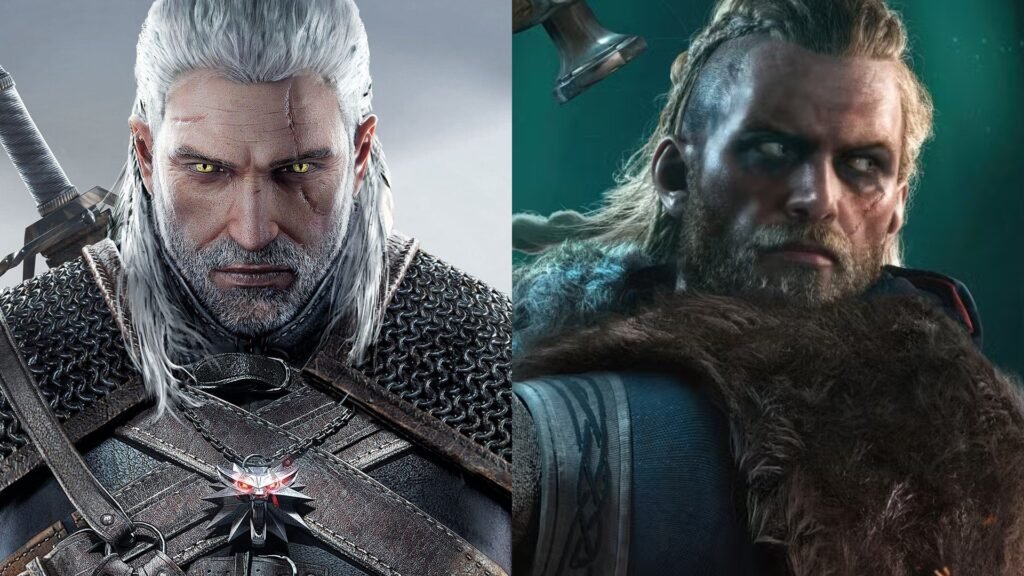
Quick Points
- Concept: Imagine The Witcher’s Geralt replacing Eivor as the lead in Assassin’s Creed Valhalla.
- Tone Shift: The story becomes quieter and more introspective, trading conquest for moral consequence.
- Combat Style: Fast, technical swordplay with Witcher Signs adding tactical depth.
- World Focus: Monster contracts replace raids; folklore and curses replace politics and territory.
- Factions: The Hidden Ones would respect Geralt’s skill but question his neutrality; the Order would try to control him.
- Exploration: A slower, more atmospheric journey through a haunted, myth-filled England.
- Themes: Less about destiny and glory, more about identity, choice, and what it means to stay human in a world of gods and monsters.