


High-Skill, Low-Hassle: The Best Timing Games for Busy Players
Some games reward preparation. Others reward experimentation. And then there are games that reward one specific skill above all else: timing. If you are good…
Cuphead blends hand-drawn 1930s cartoon animation with tightly structured boss encounters built around short, repeatable attempts. Most fights last only a few minutes, but demand precise timing, pattern recognition, and clean execution. This makes it a strong fit for the Sprint Player who prefers defined bursts of high-focus gameplay and the Resilient Player who embraces repetition as a path to mastery. The visual style and jazz soundtrack create personality, but the core appeal is the disciplined combat loop: learn the pattern, adjust your positioning, try again. Victory feels earned because improvement is measurable.
Cuphead’s 1930s animation is more than aesthetic. The hand-drawn visuals and jazz soundtrack create personality, but they also support gameplay by keeping attack patterns readable and telegraphed.
Enemy tells are distinct. Projectiles are visually consistent. Phase changes are clearly signaled. The style reinforces precision rather than distracting from it.
The story stays minimal and out of the way. The focus remains on the encounter itself.
Cuphead’s challenge is deliberate. Boss fights are structured around learning patterns, reacting cleanly, and executing within tight timing windows.
There are no artificial difficulty spikes. Attacks follow logic. Phase transitions are predictable once learned. Mistakes are traceable.
Power-ups and loadouts provide flexibility, but success ultimately comes from composure and repetition. Wins feel earned because the game is consistent.
Local co-op introduces shared recovery and positional coordination, often increasing both survivability and chaos. It can make difficult fights more manageable, but it also demands communication.
Replay value comes from refinement, not grinding. Short boss attempts encourage experimentation with different loadouts and strategies.
For Sprint Players, each attempt is a contained burst. For Resilient Players, repetition becomes a measurable path to mastery.
Cuphead’s hand-drawn 1930s animation and jazz soundtrack create immediate personality, but the presentation also serves the mechanics. Enemy tells are distinct. Projectiles are readable. Phase transitions are visually clear.
In a game built around timing windows measured in fractions of seconds, clarity matters. The art style enhances focus rather than distracting from it.
The result is a game that looks chaotic but plays with discipline.
Cuphead’s challenge is built on precision and pattern recognition. Boss fights are structured to be learned through short, repeatable attempts rather than long, drawn-out encounters.
For Sprint Players, this structure works. Most attempts last only a few minutes. You analyze what went wrong, adjust, and retry.
For Resilient Players, repetition becomes measurable growth. You recognize patterns faster. You react cleaner. Improvement is visible because mistakes are always traceable.
There is no grinding your way past difficulty. Execution is the path forward.
Local co-op introduces coordination into an already tight timing loop. Reviving a partner, spacing correctly, and managing screen space add another layer of decision-making.
It can make encounters more manageable, but it also increases chaos and requires communication.
For players who enjoy mastering difficult systems together, co-op extends replay value without changing the core short-burst structure that defines Cuphead.
Cuphead’s total length depends heavily on how quickly you adapt to timing-driven combat. Players comfortable with pattern recognition and precise movement often finish the main campaign in 10 to 15 hours. Newer players may spend closer to 15 to 20 hours as they learn boss phases and refine execution.
Progress is tied to skill, not grinding. Time invested translates directly into improved consistency and cleaner runs.
Despite its difficulty, Cuphead works extremely well in short play windows. Most boss attempts last only a few minutes, making it easy to log in, attempt several runs, and step away.
Because fights are self-contained, you never lose context between sessions. You return knowing exactly what phase gave you trouble and what adjustment to make.
For Sprint Players, this structure creates efficient, focused bursts rather than open-ended commitments.
Finishing the campaign is not the end. Many players return to chase higher ranks, cleaner victories, and faster clears.
For Resilient Players, replaying fights becomes a measurable skill exercise. You take fewer hits. You react faster. You recognize patterns earlier.
Cuphead’s replay value is built on mastery, not content sprawl. Short attempts compound into long-term improvement.
Curious what Cuphead is all about? The trailer gives you a great first look at the world, the vibe, and the kind of story you're stepping into.
These videos give some tips and pointers on getting started with Cuphead
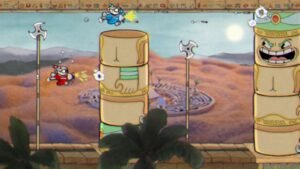
Want to see what Cuphead actually looks like in-game? These screenshots will hopefully give you a feel for what the world of Cuphead is like.
DLC just means more of a good thing. Here are some for Cuphead
The Delicious Last Course introduces Ms. Chalice, a new playable character with distinct movement and defensive tools. Her dash, double jump, and parry mechanics subtly shift how boss patterns are approached.
For Sprint Players, this adds immediate variety without extending session length. Each attempt remains short and self-contained, but the tactical approach can change meaningfully depending on character choice.
The core rhythm stays intact: read the pattern, adjust positioning, retry.
The new encounters maintain Cuphead’s formula. Patterns are readable. Phases are structured. Difficulty escalates through timing and sequencing rather than randomness.
For Resilient Players, the DLC reinforces the repetition loop that defines the base game. You analyze, adapt, and improve.
Fights remain tight and replayable, making them ideal for short bursts of focused play.
Additional weapons and charms offer new strategic options, but they do not reduce the skill ceiling. Success still depends on execution.
For Sprint Players, this means you can experiment within a 10–20 minute session and evaluate the results immediately. For Resilient Players, optimizing builds becomes another layer of refinement.
The Delicious Last Course feels like a disciplined extension, not filler content. It adds depth while respecting the short-attempt structure that makes Cuphead session-friendly.
Most players finish the main campaign in about 10 to 15 hours. Completion time depends heavily on how quickly you learn boss patterns and refine execution. Optional challenges and higher-rank runs can extend that time.
Yes. Most boss attempts last between 2 and 5 minutes, making it easy to play in short bursts. You can log in, attempt a fight several times, and log off without losing progress or context.
No. Cuphead is challenging, but enemy attacks are consistent and readable. Difficulty comes from timing and pattern recognition rather than random mechanics or artificial spikes.
Weapons and charms offer strategic flexibility, but they do not replace execution. Success still depends on learning attack patterns and reacting cleanly under pressure.
Both are viable. Solo play offers tighter control and spacing, while local co-op adds shared recovery and coordination. Co-op can make fights more manageable but also introduces additional chaos.
Great games dont have an expiration date. Take our quiz and we will find you the perfect game.
Take the QuizSome of the links on this site are Amazon affiliate links, which means if you click through and make a purchase, I may earn a small commission—at no extra cost to you. It’s a simple way to help support the site and keep the game recommendations coming. Thanks for your support!